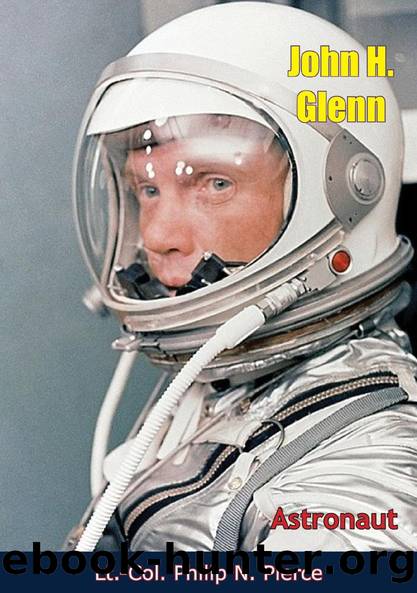
John H. Glenn, Astronaut by Lt.-Col. Philip N. Pierce
Author:Lt.-Col. Philip N. Pierce [Pierce, Lt.-Col. Philip N.]
Language: eng
Format: epub
Tags: Nonfiction, History, Military, Other, United States, Americas, 20th Century
ISBN: 9781789124293
Publisher: Papamoa Press
Published: 2018-12-01T05:00:00+00:00
NINEâThe Atlas and Friendship 7
ALTHOUGH A $400,000,000 price tag would be put on the first American capsule to orbit the earth, it is doubtful whether the dollar-and-cent aspect of the Mercury program entered the busy minds of the astronauts. But they did know, of course, that a great deal of the responsibility for making the expenditure a wise investment would ride with them from lift-off to recovery. Lift-off, however, was still several hundred million dollars worth of equipment awayâequipment that would be developed and evaluated by engineers, scientists, and the astronauts themselves.
John Glenn and his fellow astronauts were well aware that a rocket called the Atlas was already in production. Early in the space program, it had been the launch vehicle voted most likely to succeed when burdened with a man-carrying capsule. For fifteen years, scientists and engineers had worked on the Atlas, perfecting it for use as a military missile. Modifications had been made with the advent of the Mercury project and the payload adapter section had been changed to accommodate the spacecraft.
The Atlas was born back in 1946 when the United States decided it needed a missile capable of hurling an atomic warhead at a target 5,000 miles away. Years of engineering, analysis and experimentation went into the plans for the huge rocket and, by 1955, actual building was under way. Tests began in 1956. The first launching took place on November 6, 1957. The Atlas which left the pad on that occasion was basically the same launch vehicle that would eventually send an astronaut into orbit.
This mighty rocket, constructed of thin-gauge metalâless than the thickness of a dimeâwas designed to retain its structural rigidity by pressurization from its fuel tanks. Towering 65 feet from its base to the Mercury adapter section, it would stretch proudly to 93 feet when topped by a space vehicle.
When lift-off day finally arrived, the astronaut would be driven back against his âcouchâ by 360,000 pounds of thrust, developed by three of the rocketâs five engines. All engines would be ignited on the pad. The sustainer engine develops 60,000 pounds of thrust and the two booster engines, outboard of the sustainer, add another 150,000 pounds of thrust each. Two small vernier engines on the outside of the rocket are used for minor course corrections during flight; these engines develop only 1,000 pounds of thrust. A remarkable feature of the Atlas and one which contributes greatly to its reliability is the fact that it can be held on the pad with all engines going. This allows a two-or three-second electronic check of its âplumbingâ and thrust development to be made before it is released.
Download
This site does not store any files on its server. We only index and link to content provided by other sites. Please contact the content providers to delete copyright contents if any and email us, we'll remove relevant links or contents immediately.
Personalized inhaled bacteriophage therapy for treatment of multidrug-resistant Pseudomonas aeruginosa in cystic fibrosis by unknow(213381)
CONSORT 2025 statement: updated guideline for reporting randomized trials by unknow(102512)
Critical evaluation of the ProfiLER-02 study design and outcomes by Vivek Subbiah & Razelle Kurzrock(102039)
Cardiac gene therapy makes a comeback by Oliver J. Müller & Susanne Hille & Anca Kliesow Remes(101833)
Whisky: Malt Whiskies of Scotland (Collins Little Books) by dominic roskrow(74615)
Unveiling the design rules for tunable emission in graphene quantum dots: A high-throughput TDDFT and machine learning perspective by Şener Özönder & Mustafa Coşkun Özdemir & Caner Ünlü(50995)
A yeast-based oral therapeutic delivers immune checkpoint inhibitors to reduce intestinal tumor burden by unknow(40370)
Covalent hitchhikers guide proteins to the nucleus by Alexander F. Russell & Madeline F. Currie & Champak Chatterjee(40294)
Meet the Authors: Christopher R. Mansfield and Emily R. Derbyshire by Christopher R. Mansfield & Emily R. Derbyshire(40204)
Alkaline-earth metals promote propane dehydrogenation with carbon dioxide through geometric effects: Altering the reaction pathway by unknow(32812)
Induced iron vacancies boosting FeOOH loaded on sustainable Fenton-like collagen fiber membrane for efficient removal of emerging contaminants by unknow(32607)
Efficient electric-field-assisted photochemical conversion of methane to n-propanol exclusively over penetrated TiO2Ti hollow fibers by Guanghui Feng(32527)
Bi2SiO5 nanosheets as piezo-photocatalyst for efficient degradation of 2,4-Dichlorophenol by Hangyu Shi & Yifu Li & Lishan Zhang & Guoguan Liu & Qian Zhang & Xuan Ru & Shan Zhong(32463)
A novel NDIPTA organic heterojunction photocatalyst with built-in electric field for efficient hydrogen production by Jiahui Yang & Baojun Ma & Yongfa Zhu(32437)
Enhanced conversion of methane to liquid-phase oxygenates via hollow ferrite nanotube@horseradish peroxidase based photoenzymatic catalysis by Jun Duan & Shiying Fan & Xinyong Li & Shaomin Liu(32403)
Ordered macroporous superstructure of defective carbon adorned with tiny cobalt sulfide for selective electrocatalytic hydrogenation of cinnamaldehyde by Xiao-Shi Yuan & Sheng-Hua Zhou & San-Mei Wang & Wenbo Wei & Xiaofang Li & Xin-Tao Wu & Qi-Long Zhu(32330)
What's Done in Darkness by Kayla Perrin(27245)
Topological analysis of non-conjugated ethylene oxide cored dendrimers decorated with tetraphenylethylene: Insights from degree-based descriptors using the polynomial approach by A Theertha Nair & D Antony Xavier & Annmaria Baby & S Akhila(26627)
Investigation of mechanical and self-healing properties of hydroxyl-terminated polybutadiene functionalized with 2-ureido-4-pyrimidinone by Mohsen Kazazi & Mehran Hayaty & Ali Mousaviazar(26553)
